Dandelion is old. Older than the concept of a weed, older than the lawn, older than the idea that a plant needs human permission to grow somewhere. The earliest written reference we have is from ibn Sina (Avicenna) in his Al-Qanun fi al-Tibb (The Canon of Medicine), compiled around 1025 CE. He recorded dandelion as tarashaquq, prescribing it for liver and kidney disorders. But the plant was in use long before that — Chinese medical texts reference it under various names going back to at least the Tang Dynasty (618–907 CE), and it appears in Arabic pharmaceutical texts from the 9th century as a diuretic and liver remedy.
The name "dandelion" comes from the French dent de lion — lion's tooth — referring to the jagged leaf margins. Before that, the plant carried names in every language that touched it: buda in Old English herbals, piscialatto in Italian (meaning "piss-in-bed" for its diuretic punch), pissenlit in French for the same reason. Every culture that encountered this plant named it twice: once for its shape, once for what it did to your bladder.
Dandelion spread globally not by accident but by intent. European colonists brought it to North America deliberately — it was too valuable a food and medicine to leave behind. It appears on manifest lists for ships heading to the New World. The plant didn't invade; it was invited. It naturalized because it's adapted to disturbance, which is exactly what agriculture creates. Open soil? Dandelion's there. Compacted pasture? There too. Your lawn? Absolutely. It follows humans because we keep creating the conditions it loves.
The dichotomy between "revered herb" and "despised weed" is not botanical. It's political. The modern lawn is a power flex — a signal that you have so much surplus land you can afford to grow nothing on it. Herbicide companies built a multi-billion dollar industry convincing people that a plant that feeds you, heals your liver, makes your wine, and feeds your bees is an enemy. Dandelions resist that narrative by existing. Every yellow flower on a manicured lawn is a small act of refusal.
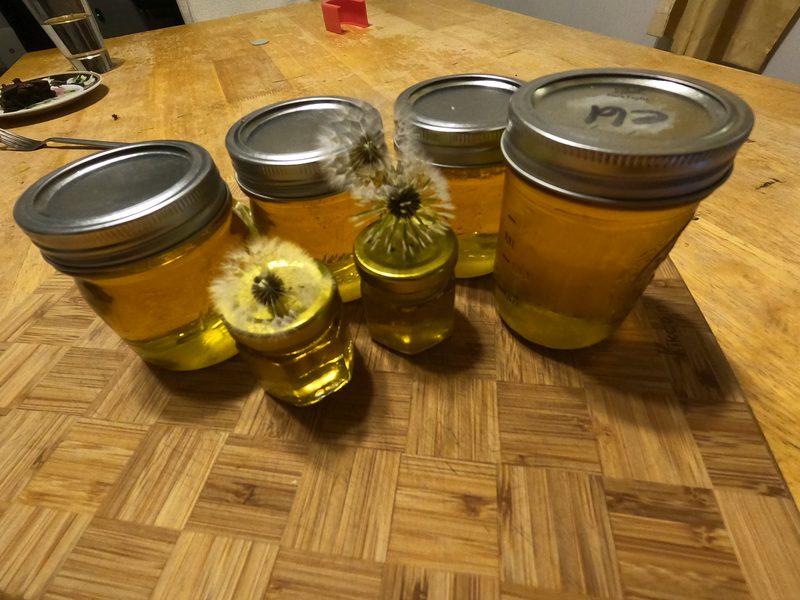
Dandelion honey — properly called dandelion honey substitute or dandelion syrup — is one of the most practical preparations you can make from this plant. It tastes floral, slightly earthy, with a warmth that sits somewhere between real honey and maple syrup. It won't fool anyone in a side-by-side taste test with the real thing, but it stands on its own as a sweetener that costs nearly nothing and uses a resource most people ignore.
Harvesting Petals
The critical step: separate the yellow petals from the green base. The green calyx at the base of each flowerhead is intensely bitter and will ruin the batch. Pinch the flowerhead at the base, twist the petals off, or use scissors to snip them free. It's tedious work. A pint of loose petals takes about an hour of picking. Put on a podcast.
Recipe: Dandelion Honey
- 4 cups dandelion petals (packed, green parts removed as thoroughly as you can manage)
- 4 cups water
- 1 lemon, sliced (adds acid and pectin — don't skip this)
- 4 cups sugar (or adjust to taste — less for a thinner syrup, more for thickness)
Bring water to a boil, add petals and lemon slices. Reduce heat, simmer 30 minutes. Remove from heat, cover, let steep overnight (or at least 4 hours). Strain through a fine mesh or cheesecloth — squeeze the petals to get everything out. Discard the petals (compost them). Return the liquid to the pot, add sugar, and simmer on medium-low heat for 1–2 hours until it reaches a syrupy consistency. It will thicken further as it cools.
Yield: Approximately 2–2.5 cups of finished honey substitute.
Flavor: Floral, slightly citrus from the lemon, earthy undertone. Not as complex as real honey but genuinely pleasant. Works well on pancakes, in tea, over yogurt, or anywhere you'd use a mild honey.
Shelf life: Processed in sterilized jars with proper seals, 6–12 months. Once opened, refrigerate and use within 3–4 weeks. Without canning, refrigerate immediately and use within 2 weeks.
Historical note: Dandelion syrup was a common sweetener in rural Europe, particularly during sugar shortages in both World Wars. It's not a hipster rediscovery — it's survival food that happens to taste good.
If dandelion honey is practical, dandelion wine is ceremonial. It's the reason to mark the season, to gather flowers in May, to have something golden to drink in December when the world is gray.
Recipe: Traditional Dandelion Wine
- 1 gallon dandelion flowerheads (packed — this is roughly 3–4 quarts of just-opened flowerheads, not petals alone)
- 1 gallon water
- 3 lbs sugar
- 2 lemons, peeled rind and juice (no pith — it's bitter)
- 1 orange, peeled rind and juice
- 1 tsp yeast nutrient
- 1 packet wine yeast (Lalvin EC-1118 or similar — champagne yeast works well)
Pour boiling water over the flowerheads. Cover and let steep 24–48 hours. Strain through cheesecloth — squeeze the flowers to extract maximum flavor. Add sugar, citrus juices, and citrus rinds to the liquid. Heat gently to dissolve sugar. Let cool to room temperature (below 80°F). Add yeast nutrient and pitch yeast. Ferment in primary for 5–7 days, stirring daily. Rack to secondary fermenter, leaving citrus rinds and sediment behind. Fit airlock. Ferment 2–3 months until fermentation slows significantly. Rack again, let clear for another 1–2 months. Bottle. Age at least 6 months — 12 months is better. Young dandelion wine is sharp and unbalanced. Aged, it goes golden, soft, floral, with a dry honey finish that's unlike anything else.
Flavor profile: Dry to semi-sweet depending on sugar. Floral, citrus undertone, slight earthiness. Reminiscent of mead but lighter. The best batches develop a honeyed quality that justifies the name.
Common mistakes:
- Not removing green parts from flowerheads. This is the #1 killer. Green base = bitter wine. Trim the flowers down to petals only.
- Using old flowers. Pick flowers that are fully open, on a dry day, mid-morning after dew has dried. Wilted or closed flowers have less flavor.
- Rushing aging. This wine needs time. Young dandelion wine is harsh. Give it a year.
- Too much sugar. It ferments out anyway and leaves a cloying finish if you overshoot. Stick to 3 lbs per gallon for a balanced wine.
Variations:
- Ginger dandelion wine: Add 2 oz fresh grated ginger to the steep. Adds warmth and a slight kick.
- Spiced dandelion wine: Add 2 cinnamon sticks and 6 whole cloves during steep. Deeper, more autumnal.
- Mead-dandelion hybrid: Replace 1 lb sugar with 1 lb honey. Richer, more complex, and a bridge between two traditions.
Every part of the dandelion is edible. That's not a metaphor. Leaves, flowers, roots, crowns — all food. The challenge isn't edibility, it's bitterness management.
Nutritional profile (per 100g raw leaves):
- Vitamin A: ~10,160 IU — more than carrots (3 times as much)
- Vitamin K: ~778 mcg — one of the highest sources of any green
- Vitamin C: ~35 mg — comparable to many citrus fruits
- Potassium: ~397 mg — more than bananas per serving
- Iron: ~3.1 mg — more than spinach per serving
- Calcium: ~187 mg — significant for a leafy green
- Protein: ~2.7g — respectable for a green
This is one of the most nutritious greens available anywhere, including the ones you pay $4/bag for at the store. The bitterness isn't a flaw — it's the medicine. But if you want to eat a pound of it, you need to manage that bitterness.
Reducing bitterness:
- Harvest young. Spring leaves before the plant flowers are dramatically less bitter. Once the flower stalk emerges, leaves get more bitter. First-year plants that haven't bloomed yet are the mildest.
- Grow in shade. Dandelions in full sun produce more bitter compounds as a defense. Plants growing in partial shade or under taller vegetation are milder. This is the #1 reason to cultivate rather than forage — you can control this.
- Blanching. Boil leaves in salted water for 1–2 minutes, then drain. Removes a significant amount of bitterness. Do two blanching cycles for very bitter leaves. The resulting greens are still flavorful but far more approachable.
- Cooking. Sautéing with garlic and olive oil, adding to soups, braising — all reduce perceived bitterness through fat and heat. Dandelion greens with bacon fat and vinegar is a classic Italian preparation for a reason: the fat, acid, and salt all balance the bitter.
- The crown. The crown — the tight bundle of small leaves at the base, just above the root — is the sweetest part of the plant. Peel away the outer leaves and you find a pale, crisp, slightly bitter core that's excellent raw or lightly sautéed. This is what Italian farmers go for.
Using all parts:
- Young leaves: Salads, sautéed, added to soups, pesto (blanch first for pesto — trust me).
- Flowers: Fritters (dip in batter, fry), wine, tea, raw in salads (pull petals from green base).
- Roots: Roasted as coffee substitute (see below), boiled as vegetable, dried for tea.
- Crowns: The prize — peel back outer leaves, harvest the pale core. Raw, sautéed, pickled.
Why would you cultivate what most people poison? Because cultivated dandelions are better than wild-foraged ones. You control the conditions, and conditions control the bitterness. A cultivated dandelion grown in rich soil with consistent water in partial shade is a different vegetable than the bitter specimen fighting for life in your driveway crack.
Varieties worth growing:
- Catalogna Chicory-type dandelion (actually chicory, but grown and used identically — longer leaves, less bitter)
- Verte de Cambrai — French variety, bred for tenderness, excellent forced/blanched
- Amélioré à Coeur Plein — French improved variety, fuller heart, milder flavor
- Common wild-type — Free, everywhere, already adapted to your conditions. Dig up good specimens, transplant to beds. Select for leaf size and mildness over seasons.
Soil preferences: Dandelions grow everywhere but thrive in loose, fertile, slightly alkaline soil (pH 6.5–7.5). They develop deeper taproots and more bitter leaves in poor, compacted soil. Rich loam with consistent moisture produces larger, milder leaves — exactly what you want for food production. Add compost. Water during dry spells. These aren't weeds in your garden; they're a crop.
Spacing: 6–8 inches apart in rows 12 inches apart. Close enough for leaf production, far enough for the taproot to develop. If you're growing for root harvest, give 10–12 inches.
Succession planting: Sow every 2–3 weeks from early spring through early fall for continuous young leaf production. First spring sowings produce the mildest leaves. Midsummer sowings will be more bitter unless you shade them.
Blanching (field method): 2–3 weeks before harvest, cover plants with an overturned pot, board, or opaque container. Excluding light blanches the new growth pale and dramatically reduces bitterness. This is how commercial growers produce the tender crowns that sell for $12/lb at farmers' markets.
Seed saving: Let the best plants go to seed. Harvest seedheads when the fluff is fully formed and dry. Store in paper bags in a cool, dry place. Viability: 2–3 years. Dandelion seed is free everywhere, but selecting from your own best plants over generations improves your crop.
Root harvesting: Fall is best — after the first frost, the plant pulls energy into the root for winter storage. Roots are largest and most flavorful then. Dig deep and straight — the taproot can go 12+ inches down. A fork works better than a shovel for this.
Dandelion coffee (root roast): This isn't a novelty. It's a prepared root drink that's been used for centuries, was a primary coffee substitute in Europe and North America during both World Wars, and is still commercially produced. Dig roots in fall. Wash thoroughly. Chop into small pieces. Roast at 350°F on a baking sheet for 30–45 minutes until dark brown and fragrant — not black, not burnt. Grind like coffee. Brew like coffee (1 tbsp per cup, steep 5–10 minutes). The result is dark, earthy, slightly bitter, with none of coffee's acidity. It has no caffeine. It's not "almost coffee" — it's its own thing. Learn to appreciate it for what it is, not as a replacement for something else.
Medicinal uses:
- Diuretic: This is the most well-documented use across every tradition. Dandelion leaf increases urine output. Unlike pharmaceutical diuretics, it replaces the potassium it causes you to excrete. The French name pissenlit ("piss-in-bed") is not subtle about this.
- Liver support: Root preparations show hepatoprotective effects in studies. Traditional use across Chinese, Arabic, and European medicine is consistent on this point. Used as a tincture, decoction, or roasted root tea.
- Digestion: The bitter compounds stimulate bile production and digestive enzyme release. This is why bitter greens are traditionally served before meals. The bitterness isn't a bug — it's the feature.
- Skin: The white milky sap has been used topically for warts and skin spots. Less well-documented than internal uses, but widely reported in folk traditions.
Dye: Flowers produce a clear yellow dye on wool and cotton with an alum mordant. Roots produce a red-brown with iron mordant. Both are lightfast. This is a functional dye, not a novelty — enough flowers for a dye bath takes about an hour of picking, and the results are genuinely good.
Rubber — the Russian dandelion: This is one of the most remarkable chapters in this plant's history. Taraxacum kok-saghyz, the Russian dandelion, produces significant amounts of natural rubber in its root latex. During WWII, when Japan controlled Southeast Asia's rubber plantations, the Soviet Union and the United States both launched programs to develop Russian dandelion as a domestic rubber source. The Soviets had the most success, producing tires, gaskets, and other rubber products from dandelion latex during the war. The program was real, documented, and produced functional rubber products. It was abandoned after the war when plantation rubber became available again, but research has resumed in recent decades as natural rubber supply chains face disruption. Modern tire companies including Bridgestone and Continental have active research programs on dandelion rubber. This isn't speculative — it's history.
The earliest documented reference to dandelion in human records that we can verify is from the works of ibn Sina (Avicenna), the Persian polymath, in his Al-Qanun fi al-Tibb (The Canon of Medicine), completed around 1025 CE. He describes dandelion (as tarashaquq) as a diuretic and liver remedy, prescribing it for jaundice and urinary conditions. This is the earliest documented reference, not the earliest use.
Chinese medical traditions reference the plant earlier — the Xinxiu Bencao (Newly Revised Materia Medica), compiled in 659 CE under the Tang Dynasty, includes what scholars identify as dandelion under the name pugongying. However, the exact species identification in ancient Chinese texts can be ambiguous, as multiple yellow-flowered Asteraceae were grouped under similar names. The Tang Dynasty reference is likely dandelion, but we can't confirm the exact species with modern precision.
European records pick up later. Dandelion appears in the Capitulare de villis of Charlemagne (c. 800 CE), a decree listing plants to be grown on imperial estates. Whether this is specifically Taraxacum officinale or a related species is again debatable, but it's close enough that most scholars count it.
The plant itself predates all of these records by millions of years. It didn't wait for us to write about it.
Dandelion has look-alikes in the dandelion family — but none are deadly. The main risk is harvesting a more bitter or less nutritious plant. Still, know what you're picking.
Catsear (Hypochaeris radicata) — SAFE BUT DIFFERENT
- What looks similar: Rosette of deeply toothed leaves, yellow dandelion-like flowers, same lawns and disturbed areas.
- How to tell apart: Catsear leaves are hairy on both sides (dandelion leaves are hairless). Catsear flower stems are branched with multiple heads; dandelion stems are always unbranched — one stem, one flower. Catsear stems are stiff and solid; dandelion stems are hollow with white milky sap.
- Key rule: If the flower stem branches into multiple heads, it's not dandelion. Catsear is actually edible — not dangerous, just different.
Hawksbeard (Crepis species) — SAFE BUT DIFFERENT
- What looks similar: Basal rosette of lobed leaves, yellow flower heads, similar height.
- How to tell apart: Hawksbeard has branched flower stems with multiple heads and leaves on the stem. Dandelion has unbranched, leafless flower stems — all leaves come from the base rosette.
- Key rule: If there are leaves on the flower stem, or the stem branches, it's not dandelion. Hawksbeard is edible.
Sow Thistle (Sonchus species) — SAFE BUT DIFFERENT
- What looks similar: Yellow flower heads, lobed leaves, white milky sap in stems.
- How to tell apart: Sow thistle has leaves that clasp the stem (wrap around it with rounded basal lobes). Dandelion has all leaves basal — no stem leaves at all. Sow thistle leaves also have small soft prickles on the margins.
- Key rule: If the stem has leaves on it (especially leaves that clasp the stem), it's sow thistle, not dandelion. Sow thistle is edible and nutritious.
For a comprehensive look-alikes guide covering all our wild plants, see the ⚠️ Dangerous Look-Alikes reference page.
This BBS runs on labor, not venture capital. Everything here is free. If it's useful, kick in what you can. If you can't, that's fine too — take what you need and pass it on.
Monthly support keeps the node online and the knowledge flowing. All content stays free regardless.