Foraging Wild Plants in your area
The region's forests, fields, and fence rows are full of free, nutritious food. Our ancestors lived off this land for thousands of years. These plants still grow here, waiting to be harvested.
Foraging connects you to the land, provides nutrition, and builds food security. But it requires knowledge, caution, and respect.
Let's learn the lay of the land.
The Forager's Ethics
Take Only What You Need
Rules: - Never take more than 1/3 of any patch - Leave enough for the plant to regenerate - Leave enough for wildlife - Take only what you'll actually use
Why: - Sustainable harvest ensures plants return - Wildlife depends on these foods too - Overharvesting kills patches
Positive Identification is Mandatory
Never eat anything unless you're 100% certain of identification.
How to Learn: - Use multiple field guides - Take photos (plant, leaves, flowers, habitat) - Join local foraging groups - Learn from experienced foragers - Start with easy, distinctive plants - When in doubt, leave it out
Deadly Look-Alikes: - Wild carrots vs. poison hemlock - Ramps vs. lily of the valley (toxic) - Morels vs. false morels - Chickweed vs. scarlet pimpernel (mildly toxic)
Respect the Land
Permission: - Ask before foraging on private land - Some public lands restrict foraging (check regulations) - National forests: generally OK for personal use - State parks: usually prohibited - Nature preserves: never forage
Leave No Trace: - Don't damage habitat - Pack out trash - Don't leave piles of plant debris - Close gates
Wildlife: - Don't strip an area - Leave berries for birds - Leave nuts for squirrels - Share the bounty
Seasonal Foraging Calendar
Spring (March-May)
Early Spring (March-April): - Ramps (wild leeks) - Fiddleheads (ostrich fern only) - Watercress - Dandelion - Violet leaves and flowers - Chickweed - Stinging nettle (young shoots)
Late Spring (April-May): - Morel mushrooms - Wood nettle - Sorrel - Plantain (young leaves) - Wild mustard - Blue violets - Redbud flowers
Summer (June-August)
Early Summer (June): - Strawberries (wild) - Black raspberries - Elderberries (flowers first, then berries) - Chickweed (still going) - Lambsquarters - Amaranth
Mid-Summer (July): - Blackberries - Raspberries - Mulberries - Serviceberries - Poke (young shoots only, properly prepared) - Summer mushrooms (chicken of the woods, chanterelles)
Late Summer (August): - Apples wild/apples) - Grapes (wild) - Blackcaps - Nuts beginning (hickory, early walnuts) - Late berries
Fall (September-November)
Early Fall (September): - Acorns (all oak species) - Hickory nuts - Black walnuts - Butternuts - Beechnuts - Persimmons (after frost) - Grapes (late varieties) - Mushrooms (chanterelles, hen of the woods, lobster mushrooms)
Late Fall (October-November): - Persimmons (peak) - Late nuts - Rose hips (after frost, high in vitamin C) - Some mushrooms continue - Roots (some plants, but research carefully)
Winter (December-February)
Limited but Possible: - Evergreen needles (pine tea, high in vitamin C) - Inner bark (emergency food, survival) - Dried berries still on bushes - Mushrooms (oyster mushrooms in mild weather) - Roots (some, but many plants dormant)
Winter is for: Planning, studying guides, processing stored harvest
Easy Beginner Plants
These have no deadly look-alikes and are easy to identify.
1. Dandelion (Taraxacum officinale) — The People's Plant
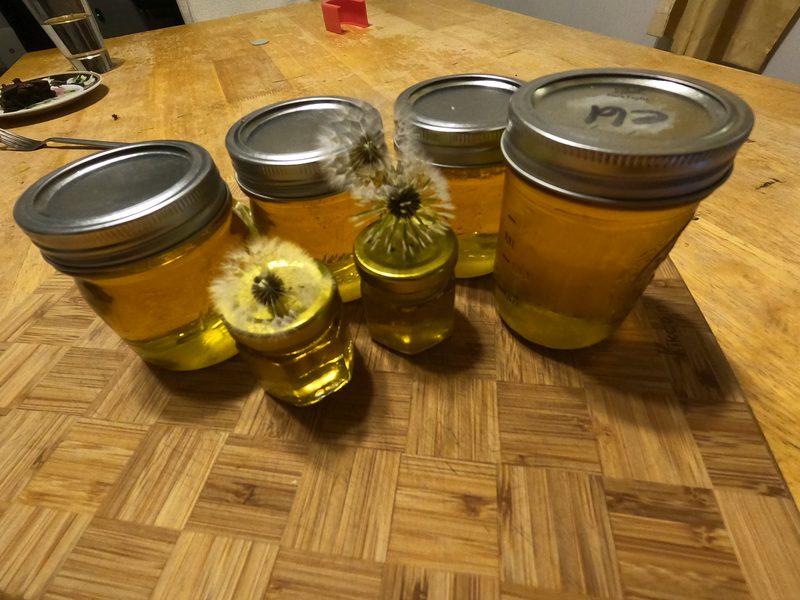
Dandelion honey made at the Loop
Identification:
- Jagged leaves in rosette pattern
- Yellow flowers on hollow stems
- White milky sap in stems
- All parts edible — leaves, flowers, roots, crowns
- No deadly look-alikes (cat's ear is similar but also edible)
Taste: Bitter (milder in spring, reducible with blanching or shade-growing)
Nutrition: One of the most nutrient-dense greens available — more Vitamin A than carrots, more iron than spinach, more calcium than kale. This isn't garnish. This is food.
Uses:
- Leaves: Salads, sautéed, pesto, soup green. Blanch to reduce bitterness.
- Flowers: Dandelion honey (syrup), wine, fritters, tea. The honey substitute is genuinely good.
- Roots: Roasted for coffee substitute, medicinal tea, prebiotic inulin source.
- Crowns: The tender base where leaves meet root — peel and eat like a miniature heart.
History: Oldest recorded reference: Al-Razi (c. 900 CE) in Arabic medicine. Chinese pharmacopoeia (659 CE). Brought to North America deliberately by European settlers as food and medicine — it didn't "invade," it was invited.
Cultivation: Yes, you can grow these on purpose. Varieties like Improved Broadleaf (À Cœur Plein) produce larger, less bitter leaves. Blanch by covering with pots 2-3 weeks before harvest for tender, pale crowns.
Season: Spring through fall (best young, in spring)
→ Full dandelion write-up: honey recipe, wine recipe, cultivation, history, rubber
2. Violet (Viola species)
Identification: - Heart-shaped leaves - Purple, white, or yellow flowers - Low-growing rosette - All parts edible
Taste: Mild, slightly sweet
Uses: - Leaves: Salads, cooked greens - Flowers: Salads, candied, tea - High in vitamin C
Look-alikes: None deadly
Season: Spring (leaves), spring-summer (flowers)
3. Blackberry/Raspberry (Rubus species)
Identification: - Thorny canes - Compound leaves (3-5 leaflets) - White flowers - Aggregate fruit (many small drupelets)
Taste: Sweet-tart
Uses: - Berries: Fresh, pies, jams, wine - Leaves: Tea (excellent for pregnancy) - Young shoots: Peeled and eaten
Look-alikes: None deadly (but watch for pesticides)
Season: Early summer (blackberries), spring-summer (raspberries)
4. Chickweed (Stellaria media)
Identification: - Small oval leaves - Tiny white star-shaped flowers - Crawling/stems - Single line of hair on stem
Taste: Mild, like corn silk
Uses: - Fresh in salads - Sautéed as green - Salve for skin irritation
Look-alikes: Scarlet pimpernel (mildly toxic, has square stems)
Season: Cool weather (spring, fall, even winter)
5. Plantain (Plantago major, P. lanceolata)
Identification: - Broad or narrow leaves with parallel veins - Seed stalks rise from center - Broadleaf has oval leaves - Buckhorn has narrow leaves
Taste: Mild, slightly earthy
Uses: - Young leaves: Salads, cooked - Seeds: High in fiber - Medicinal: Chewed leaf on stings/bites
Look-alikes: None deadly
Season: Spring through fall (best young)
6. Mulberry (Morus species)
Identification: - Trees with variable leaf shapes - Black or red berries (not white when ripe) - Berry looks like elongated blackberry - No thorns
Taste: Sweet
Uses: - Berries: Fresh, pies, jams - Massive quantities possible
Look-alikes: None deadly
Season: Early summer (2-3 week window)
Note: Trees produce ENORMOUS quantities. Great for beginners.
Intermediate Plants (Learn After Mastering Basics)
Ramps (Allium tricoccum)
Identification: - Wild leek - Broad leaves (2-3 per plant) - Strong onion/garlic smell - White bulbs
Taste: Strong onion-garlic
Uses: - Bulbs: Fried, pickled - Leaves: Pesto, salads, cooked
Look-alikes: - Lily of the valley (toxic, no onion smell) - False hellebore (deadly, no onion smell)
Test: MUST smell like onion/garlic. If no smell, DON'T EAT.
Season: Early spring (March-April)
Sustainability: - Harvest only 1/3 of any patch - Harvest leaves only (leave bulb to regrow) - Many places overharvested (be careful)
Morel Mushrooms (Morchella species)
Identification: - Honeycomb cap (pitted, not smooth) - Hollow stem - Cap attached to stem at bottom - Gray, yellow, or black
Taste: Earthy, nutty
Uses: - Sautéed - Dried for storage
Look-alikes: - False morels (toxic, cap not fully attached, not truly hollow)
Test: Cut lengthwise. Must be completely hollow. Cap must attach at bottom of stem.
Season: Spring (April-May, when redbud blooms)
Note: Expensive in stores ($20-40/lb). Free in woods.
Stinging Nettle (Urtica dioica)
Identification: - Square stems - Opposite, serrated leaves - Stinging hairs (ouch!) - Grows in moist areas
Taste: Spinach-like when cooked
Uses: - Young shoots: Sautéed, tea - Dried: Tea (excellent for allergies) - Fiber (historical use)
Look-alikes: None deadly, but some plants don't sting
Test: Must sting when touched (use gloves)
Season: Spring-early summer (cut top 4-6 inches)
Preparation: Cooking or drying destroys sting. Handle with gloves until cooked.
Dangerous Look-Alikes (Learn These!)
Poison Hemlock vs. Wild Carrot/Queen Anne's Lace
Poison Hemlock (Conium maculatum): - DEADLY - Purple-spotted stems - Hairless stems - Musty/mousy odor - Tall (up to 10 feet)
Wild Carrot (Daucus carota): - Edible (young roots) - Hairy stems - No spots on stems - Carrot smell - Shorter (2-3 feet)
Rule: Never eat anything carrot-family unless 100% certain. Too risky for beginners.
Wild Leeks vs. Lily of the Valley
Wild Leeks (Allium tricoccum): - Edible - Onion/garlic smell - Single stem from bulb
Lily of the Valley (Convallaria majalis): - TOXIC - No onion smell - Two leaves from base
Rule: ALWAYS smell. If no onion/garlic smell, DON'T EAT.
Medicinal Uses
Many foraged plants have medicinal properties.
Common Medicinals:
Plantain: - Chewed leaf on bee stings - Draws out venom - Reduces swelling
Dandelion: - Root: Liver tonic, diuretic - Leaf: Diuretic (high in potassium) - Flower: Mild digestive aid
Nettle: - Tea for allergies - Cooked for spring tonic - High in vitamins and minerals
Violet: - Leaf: Expectorant - Flower: Lymphatic - Gentle, safe
Elderberry: - Berries: Immune support - Flowers: Colds and flu - Cook berries (raw berries mildly toxic)
Important: Learn proper dosing, preparation, and contraindications. Some herbs interact with medications.
Processing and Storage
Drying Greens
Method: - Wash and dry - Remove tough stems - Bundle and hang (dark, dry place) - Or use dehydrator (95-105°F) - Crush when completely dry - Store in glass jars
Good for Drying: - Nettle - Violet leaf - Plantain - Mint - Bee balm
Freezing Berries
Method: - Wash and dry thoroughly - Spread on baking sheet - Freeze until solid - Transfer to freezer bags - Remove air, seal
Good for Freezing: - All berries - Mulberries - Elderberries
Making Syrups and Cordials
Basic Syrup: - 1 part juice to 1 part sugar - Heat to dissolve - Add lemon juice - Refrigerate or can
Uses: - Mulberry syrup - Elderberry syrup (immune support) - Violet syrup (coughs)
Tinctures
Method: - Fresh or dried herb - Cover with 80-100 proof alcohol (vodka, brandy) - Steep 4-6 weeks - Strain, bottle - Label with date and contents
Uses: - Long-term storage of medicinal properties - Small doses - Concentrated
Foraging Safety
Pollution Concerns
Avoid: - Roadsides (heavy metals from cars, within 50 feet minimum) - Industrial areas - Old orchards (may have lead arsenate pesticides) - Lawns treated with herbicides (wait 2+ years after treatment) - Dog walking areas - Areas downstream from pollution
Safer Locations: - Deep woods - Your own land (you know the history) - Protected areas - Organic farms (with permission)
Parasites
Concerns: - Raccoon roundworm (in raccoon latrines) - Giardia (in water sources) - Generally low risk from plants themselves
Prevention: - Wash thoroughly - Cook when possible - Avoid areas with heavy wildlife traffic - Don't forage low to ground in raccoon areas
Poison Ivy Awareness
Identification: - "Leaves of three, let it be" - Shiny leaves (usually) - Can be vine or shrub - White berries - Causes rash in most people
Where Grows: - Edges, not deep shade - Along trails - Often near poison oak or sumac
If You Touch It: - Wash immediately with soap and water - Don't touch face - Wash clothes separately - Jewelweed or plantain can help (topical)
Building Your Knowledge
Study Resources
Books: - "Appalachian Foraging" by Timothy Lee Scott (specific to our region) - "Stalking the Wild Asparagus" by Euell Gibbons (classic) - "The Forager's Harvest" and "Nature's Garden" by Samuel Thayer (excellent) - "Peterson Field Guide to Edible Wild Plants"
Apps: - PictureThis (plant identification) - iNaturalist (community ID) - Note: Don't rely solely on apps—use multiple sources
Local Resources: - your local Extension (sometimes offers classes) - Local herbalists - Homesteading groups - Older neighbors (traditional knowledge)
Start Small
Year One: - Master 5-10 easy plants - Learn them in all seasons - Understand their habitat - Practice identification
Year Two: - Add 5-10 more - Start processing/storing - Try medicinal uses
Year Three+: - Expand to mushrooms - Learn roots and barks - Become teacher yourself
Keep Records
Foraging Journal: - Date and location - What you found - How much - How prepared - Notes on taste, quality - Photos
After a few years, you'll know your land intimately—when things come in, where the best patches are, how abundance varies.
The Bottom Line
The region is a treasure trove of free, nutritious food. Our ancestors foraged these plants for thousands of years. That knowledge is still available if we seek it.
Start easy. Be certain. Take only what you need. Share the bounty with wildlife.
Over time, you'll see the landscape differently. Those "weeds" become food. Those woods become grocery stores. That roadside becomes medicine cabinet.
Welcome to foraging, neighbor. The land is generous to those who know how to ask.