Chester D. Schwartze
Washington State's first official strawberry breeder. He built the foundation stock that Pacific Northwest strawberry growing still stands on, and he did it from a research station in Puyallup over four decades.
not yet
located
- Class of 1924, then a PhD in horticulture in 1935, both from what was then the State College of Washington.
- Hired in 1932 as the state's first official strawberry breeder, at the WSU Puyallup research and extension center.
- Worked in the WSU small fruit breeding program from 1932 to 1969, and developed nine varieties before he retired in 1970.
- In 1975 the American Pomological Society gave him the Wilder Medal, their highest award, for his Rubus breeding. Rubus is the bramble genus: raspberries and blackberries.
- WSU Libraries recorded an oral history interview with him on 3 April 1981. The tapes and a typed abstract survive in their digital collections.
The varieties he bred
Northwest
Strawberry · 1949His most influential release
Northwest carried commercial strawberry production on the Pacific Coast. WSU's own history says that for a time in the 1960s it was the most widely planted strawberry in the country. It became foundational breeding stock as well: Northwest is a parent of Shuksan (1970), Rainier (1972) and Totem (1972), three varieties that went on to be grown commercially in their own right.
The plant itself is a good one. Large, bright, glossy red fruit that turns dark when fully ripe, with fine sweet flavor and excellent quality for preserves and jam. Vigorous, very productive and erect, which makes picking easy. Resistant to root rot and mildew, and susceptible to red stele on infested soil. It bears its whole crop over a short period and ripens in early June. It is not particularly winter hardy.
Puget Beauty
Strawberry · 1956The parent that keeps showing up in modern pedigrees
A sweet, aromatic berry, and one of the most useful parents the program ever produced. Puget Beauty turns up in the family tree of many of today's Pacific Northwest cultivars, Quinault among them. When a breeder wants winter hardiness and flavor together, they go back to this plant.
Quinault
Everbearing strawberry · 1967The one we grow · from a cross made in 1958
An everbearing strawberry, which means it fruits over a long season instead of in one flush, so you pick from late spring into the fall. Berries are large to very large, round to round-conic, soft, bright red and sweet. The plants reach 8 to 12 inches tall with about a foot of spread, and they will set fruit on unrooted runners, which is unusual and useful for anybody propagating their own stock.
Quinault = WSU 901 × Puget Beauty
WSU 901 was a sibling of Nisqually. Puget Beauty is Schwartze's own 1956 release.
It was one of his final major releases.
Meeker
Red raspberry · 1967Still the workhorse of the Washington raspberry crop
Schwartze was WSU's first raspberry breeder as well as their first strawberry breeder, and he started on brambles at Puyallup in 1932. Growers had come to the station four years earlier asking for something with better winter hardiness than the Cuthbert they were then growing.
Meeker was the answer, released in 1967. It became one of the most commercially important red raspberries in the region and it never left. WSU's own account says that of roughly 9,500 acres of raspberries grown in Washington, most of them are Meeker, and that it still offers great fruit quality and yield. Its one weakness is susceptibility to raspberry bushy dwarf virus, which is transmitted on pollen and degrades the berry.
A strawberry breeder whose raspberry is still the standard crop half a century later is a fair reason to hand somebody a medal, and in 1975 that is exactly what the American Pomological Society did.
Named for him
'Schwartze' ('Puget Summer'®)
Strawberry · 2002Not his release · named in his honour
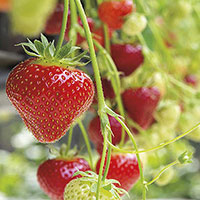
Photo: Washington State University. Variety released by WSU and the USDA Agricultural Research Service.
Thirty-three years after he retired, WSU named a strawberry after him. Patrick Moore and Chad Finn released it in 2002 with the cultivar name 'Schwartze', marketed as Puget Summer, under US Plant Patent 12,067. The published release notice says plainly why: the name "was selected to reflect the contributions of C.D. Schwartze to the WSU small fruit breeding program from 1932 to 1969."
It is a short-day variety bred for the fresh market, tested from 1998, with the latest midpoint of harvest in its trial group. We list it here because people searching for his varieties will find it, and it is worth being clear that he did not breed it. His colleagues did, and they put his name on it.
What he left behind
WSU Puyallup has been breeding strawberries since the early 1940s and has released thirteen varieties. Schwartze bred nine of them by himself. The program he started is still running, and WSU's small fruit work is the source of a large share of the strawberries grown in Washington, Oregon and British Columbia.
For our purposes the accounting is simpler. The Quinault plants in our beds trace back to a cross made in 1958 at a public research station, by a public employee, and released to everybody. No licence, no royalty, no variety protection stopping us from saving runners and planting them out. That is the whole argument for public plant breeding, and we did not have to make it up. It is sitting in the ground outside.
Where the evidence is thin
- The 1949 release date for Northwest. This is the date we were given and the date most often repeated, but we could not find it stated on any WSU page we could reach. His own 1981 oral history abstract is a typewritten scan and the only year we could pull from it was ambiguous. The 1949 figure should be treated as unconfirmed until we find a release notice or a station bulletin that states it.
- "More extensively planted than any other strawberry in the world" is stronger than the source supports. WSU's published history says "the most widely planted strawberry in the country." Those are different claims. We have written the sourced version on this page. If a global figure exists we have not found it, and we are not going to quietly upgrade the sentence to make him sound more important than the record does.
- No photograph. See below.
The missing portrait
We were asked to use his picture from the WSU website. We searched and did not find one. Specifically, we checked the WSU Magazine strawberry and raspberry features, the WSU Puyallup small fruit pages, the WSU Libraries digital collections search interface for every collection, Wikimedia Commons, and the WSU-hosted PDF of the 2002 release notice for 'Schwartze'. The magazine articles illustrate their stories with modern photos of fruit, not portraits of breeders. His oral history in the WSU Libraries collection is audio plus a typed abstract and carries no portrait.
A yearbook portrait almost certainly exists. The Chinook, WSU's yearbook, ran for his class of 1924 and is digitised, but that volume runs to 440 pages and we have not hunted through it page by page. If you know the photograph you had in mind, send us the link and it goes in the frame.
Shuksan · Rainier · Totem
1970 · 1972 · 1972Descendants, not his own releases
These three carry Northwest in their pedigree and are the clearest measure of how much weight his work still holds. Shuksan came from (Northwest × Sierra) × Columbia. Rainier came from WSU 685 (Northwest × Sierra) × Columbia. Totem, bred in Canada, came from Puget Beauty × Northwest. Two Schwartze varieties in a single parent line, twice over.
Sources
- Moore, P.P. and C.E. Finn. "'Schwartze' ('Puget Summer'®) Strawberry." HortScience 37(1):230-232, 2002. Published by the USDA Agricultural Research Service and WSU. WSU-hosted PDF. Source for the 1932 to 1969 programme dates, the list of cultivars he developed, the US Plant Patent 12,067, and the reason for the name.
- "The best berries." Washington State Magazine, 29 April 2010. magazine.wsu.edu. Source for the 1932 hire as first official strawberry breeder, the 1956 Puget Beauty release, and the "most widely planted strawberry in the country" statement about Northwest.
- "Strawberries." Washington State Magazine, 24 April 2022. magazine.wsu.edu. Source for his degrees ('24, '35 PhD Hort.), the nine varieties and the 1970 retirement, and WSU's thirteen total releases.
- "Raspberries." Washington State Magazine, 26 April 2012. magazine.wsu.edu. Source for Meeker's 1967 release, for Schwartze being WSU's first raspberry breeder, for the 1932 start at Puyallup, and for most of Washington's roughly 9,500 raspberry acres still being Meeker.
- American Pomological Society, "History of Wilder Award Winners." PDF. 1975 entry: "Chester D. Schwartze, Washington. Rubus breeding."
- Wikipedia, "List of strawberry cultivars," consulted for the Quinault parentage (WSU 901 × Puget Beauty), the Northwest plant description, and the pedigrees of Shuksan, Rainier and Totem. Secondary source, used only for cultivar description where it agrees with WSU material.
- WSU Libraries digital collections, oral history interview with Chester D. Schwartze recorded 3 April 1981: audio tapes plus a typed abstract. collection record.